RBC Preferred Share ETF (RPF): Complete Guide for Canadian Income Investors
# RBC Preferred Share ETF (RPF): Complete Guide for Canadian Income Investors
TL;DR: RBC Canadian Preferred Share ETF (RPF) delivers 5.5% yield with active management, 122 holdings, and 0.58% MER. Best for income-focused investors who want monthly distributions from Canadian preferred shares. Buy if you need steady income; skip if you want capital appreciation or can't tolerate rate sensitivity.
---
What Is RBC Canadian Preferred Share ETF (RPF)?
RBC Canadian Preferred Share ETF trades on the Toronto Stock Exchange under ticker RPF. It holds 122 Canadian preferred shares and pays monthly distributions.
The fund launched September 20, 2016. RBC Global Asset Management runs it with an active mandate—not passive index tracking.
Quick stats (as of March 10, 2026):
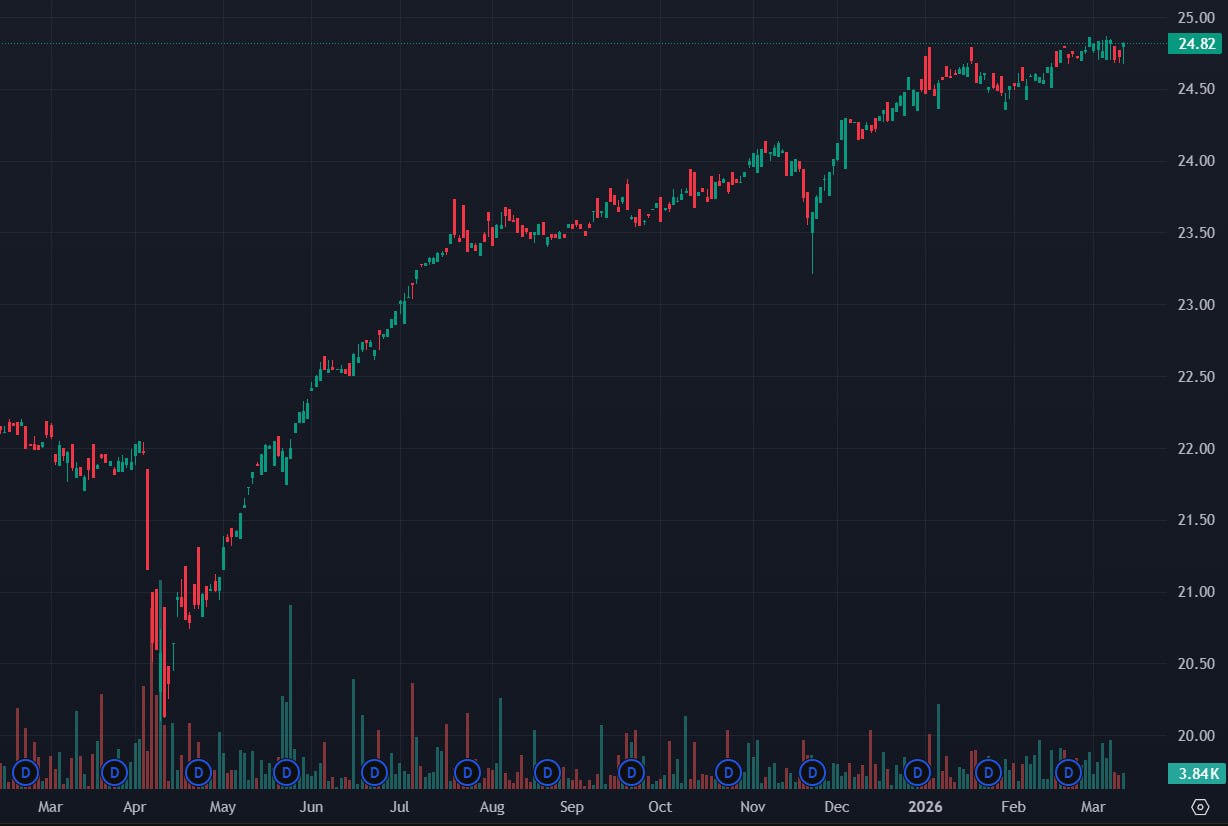
RPF price performance over time
---
How RPF Works
#
What It Owns
RPF buys rate-reset preferred shares issued by Canadian companies. These are hybrid securities—somewhere between bonds and common stock.
Rate-reset preferreds pay a fixed dividend for a set period (usually 5 years), then reset to a new rate based on a benchmark plus a spread. If rates rise, your yield rises. If rates fall, you might get called out of the position.
Portfolio breakdown by sector:
All 122 holdings are Canadian issuers. You get zero geographic diversification, which is the point—pure Canadian preferred share exposure.
#
Top 10 Holdings (March 2026)
| Holding | Weight |
|---------|--------|
| BCE Inc Series AK Preferred | 2.67% |
| Enbridge Inc Series 11 Preferred | 2.54% |
| TransAlta Corp Series A Preferred | 2.18% |
| Cenovus Energy Inc Series 1 Preferred | 1.84% |
| TD Bank Series 1 Preferred | 1.83% |
| TC Energy Corp Series 5 Preferred | 1.80% |
| TC Energy Corp Series 7 Preferred | 1.73% |
| Brookfield Corp Series 24 Preferred | 1.61% |
| Power Financial Corp Series P Preferred | 1.60% |
| National Bank Series 38 Preferred | 1.53% |
Top 10 makes up 19.3% of the portfolio. Diversification across 122 securities keeps issuer risk manageable.
---
The Yield: What You Actually Get
#
Monthly Distributions
RPF pays monthly. Recent distributions:
| Month | Distribution |
|-------|-------------|
| Jan 2026 | $0.10 |
| Feb 2026 | $0.10 |
| Dec 2025 | $0.105 |
| Nov 2025 | $0.105 |
| Oct 2025 | $0.11 |
2025 total: $1.25 per unit
2024 total: $1.19 per unit
2023 total: $1.11 per unit
Distributions are trending up. That's the rate-reset mechanism working—higher rates flow through to higher payouts.
#
Distribution Composition
Not all distributions are equal. RPF's 2025 distributions broke down as:
Return of capital reduces your cost basis. It's not taxed as income immediately, but you pay capital gains later. For non-registered accounts, this matters for tax planning.
#
Yield vs. Alternatives
| Investment | Yield |
|------------|-------|
| RPF | 4.84% - 5.54% |
| iShares S&P/TSX Canadian Preferred Share Index ETF (CPD) | ~4.5% |
| BMO Laddered Preferred Share Index ETF (ZPR) | ~4.3% |
| 5-year GIC | 3.5% - 4.0% |
| Canadian dividend stocks (average) | 3.0% - 4.5% |
RPF yields more than passive alternatives because:
1. Active management targets higher-yielding issues
2. Rate-resets captured rising rates from 2022-2025
3. No currency hedging drag (100% CAD)
---
Performance: Does It Actually Make Money?
#
Total Return (NAV)
| Period | Return |
|--------|--------|
| YTD 2026 | +2.21% |
| 1 Year | +18.24% |
| 3 Years (annualized) | +15.17% |
| 5 Years (annualized) | +8.39% |
| Since Inception | +7.58% |
2024 calendar year: +18.74%
2023 calendar year: +3.62%
2022 calendar year: +28.46%
2022 was the anomaly. Rate-resets surged as the Bank of Canada hiked rates from 0.25% to 4.75%. Preferred shares that reset at higher spreads delivered massive gains.
2023 was the hangover. Markets priced in rate cuts that didn't materialize fast enough.
2024-2025 saw sustained returns as rate-resets continued resetting at attractive levels.
#
What Drives Returns
Three factors move RPF:
1. Interest rates. Rising rates = rising resets = higher yields and price appreciation. Falling rates work in reverse.
2. Credit spreads. Financial stress widens spreads on preferred shares. The 2020 crash and 2023 regional bank scare both hit preferred shares hard.
3. Dividend sustainability. Preferred dividends can be suspended. RPF holds cumulative preferreds (arrearages must be paid) and non-cumulative (no obligation). The mix matters.
---
Risks Nobody Talks About
#
1. Rate-Reset Timing Mismatch
RPF's holdings reset at different times. Here's the current breakdown:
| Time to Reset | % of Portfolio |
|---------------|----------------|
| Under 1 year | 21.2% |
| 1-2 years | 20.1% |
| 2-3 years | 18.5% |
| 3-4 years | 21.6% |
| 4-5 years | 17.0% |
| Other | 1.7% |
Why this matters: If rates fall, 40%+ of holdings reset within 2 years at lower rates. Your yield drops. If rates rise, you capture upside—but so does everyone else, so price appreciation is limited.
#
2. Preferred Share Complexity
Preferred shares are the most misunderstood security in Canada. Key gotchas:
RPF's weighted average credit rating is Pfd-2L (low end of adequate). Credit risk exists.
#
3. Liquidity Risk
Preferred shares trade thinly. RPF itself has decent liquidity (13,201 average daily volume as of March 2026), but underlying holdings can gap down on bad news.
During the March 2020 crash, preferred shares fell harder than common stock. Investors who needed to sell took 30-40% losses.
#
4. Tax Drag in Registered Accounts
RPF distributions are mostly dividend income—eligible for the dividend tax credit outside registered accounts.
Inside an RRSP or TFSA:
The dividend tax credit only applies outside registered accounts — the tax advantage of the underlying dividend stream is unused inside RRSPs and TFSAs.
---
Fees: Is Active Management Worth It?
RPF charges 0.58% MER.
Passive alternatives:
You're paying 13 basis points extra for active management. Does it pay off?
Performance vs. CPD (2022-2025):
The gap isn't massive, but RPF performed modestly better over the measured window. The mandate allows the manager to:
Whether 13 bps is justified depends on one's view of active management; RBC GAM's fixed income team has a multi-year track record managing the fund.
---
Investor Characteristics Often Associated With RPF
#
Characteristics that align with the structure:
#
Characteristics that conflict with the structure:
---
How to Buy RPF
1. Open a brokerage account with access to TSX
2. Fund your account (CAD required)
3. Search ticker "RPF" on the TSX
4. Place a limit order at or near NAV (check morningstar.ca or rbcgam.com for current NAV)
5. Consider DRIP if you want automatic reinvestment
Minimum investment: 1 unit (~$25 CAD)
Commission: Varies by broker (often $0 at discount brokers)
---
RPF vs. Alternatives
#
RPF vs. CPD
| Factor | RPF | CPD |
|--------|-----|-----|
| Management | Active | Passive |
| MER | 0.58% | 0.45% |
| Holdings | 122 | ~60 |
| Yield | Higher | Lower |
| Volatility | Lower (more holdings) | Higher (concentrated) |
RPF offers active management and broader diversification; CPD offers lower fees and passive exposure.
#
RPF vs. Individual Preferred Shares
Buying preferred shares directly eliminates the MER. But you take on:
Diversification math explains the common rule of thumb that investors with smaller portfolios often use ETFs for preferred share exposure, while larger portfolios can spread direct holdings across enough issuers to achieve comparable diversification if they're willing to do the research.
#
RPF vs. Dividend Stocks
| Factor | RPF | Dividend Stocks |
|--------|-----|-----------------|
| Yield | 5.0%+ | 3.5-4.5% |
| Capital appreciation | Limited | Higher potential |
| Volatility | Rate-driven | Earnings-driven |
| Tax treatment | Dividend tax credit | Dividend tax credit |
| Complexity | High | Lower |
RPF's structure emphasizes yield. Dividend stocks' structure offers more total-return potential. The two categories are often held for different roles in a portfolio.
---
Summary of Structural Trade-offs
Characteristics aligned with RPF's structure:
Characteristics that conflict with RPF's structure:
#
Bottom Line
RBC Canadian Preferred Share ETF delivers what it promises: monthly income from Canadian preferred shares with active management. Its 5%+ distribution rate is high relative to most fixed-income alternatives, and it carries rate risk and structural complexity.
Net assessment: the structure serves specific portfolio roles well and others poorly — fit depends entirely on the individual investor's circumstances.
---
Frequently Asked Questions
#
What is the RBC Preferred Share ETF ticker?
The RBC Canadian Preferred Share ETF trades on the Toronto Stock Exchange under ticker RPF.
#
What is the RPF ETF yield?
RPF currently yields 4.84% - 5.54% (distribution yield vs weighted average dividend yield). Distributions are paid monthly.
#
How does RPF's structure fit different investor situations?
RPF's structure serves income-focused investors with non-registered accounts who want monthly distributions from Canadian preferred shares. Investors who need capital preservation or hold only registered accounts (TFSA/RRSP) may find the structure conflicts with their needs.
#
What does RPF invest in?
RPF invests in 122 Canadian preferred shares, primarily rate-reset preferreds issued by financial institutions, energy companies, and utilities.
#
How often does RPF pay distributions?
RPF pays monthly distributions. Recent monthly payments have been approximately $0.10 per unit.
#
What is the MER for RPF?
RPF charges a 0.58% Management Expense Ratio (MER), which is slightly higher than passive alternatives like CPD (0.45%) and ZPR (0.45%).
#
Can I hold RPF in a TFSA or RRSP?
Yes, you can hold RPF in registered accounts. However, the dividend tax credit on the distributions is only usable in non-registered accounts, which is why the fund is often discussed in that context.
Where to Learn More
---
Last updated: March 2026. Data sourced from RBC Global Asset Management. Past performance does not guarantee future results. This is not financial advice—consult a licensed advisor for your situation.